LechExperiencePath
From Landsberg to Füssen, against the wild river 💦🏞️💚
Between historic flair and alpine expanse, this section of the Lech Experience Trail (Lech ErlebnisWeg) accompanies you on a fascinating journey along one of the last untamed alpine rivers. From the medieval town of Landsberg am Lech to the Königswinkel region around Füssen, you hike through a landscape that changes with every step. First, the gentle foothills of the Alps reveal themselves; later, the backdrop of the Alps grows on the horizon, announcing your path towards the mountains 🏔️✨. The river accompanies you almost continuously. Sometimes the Lech glides calmly through wide floodplains, sometimes it rushes over bright gravel banks and shallow currents. Its turquoise-blue water magically attracts the eye and makes nature feel particularly intense 💙💧. Light forests, open meadows, and quiet riverbanks create an atmosphere between energy and relaxation.
A special highlight of the trail is the famous Litzau Loop (Litzauer Schleife), one of the most impressive river bends in Bavaria. Here, the Lech presses in a large curve through a wild and romantic landscape of rocks and forest. From the viewpoints, a panorama unfolds that delights every nature lover. The loop is a natural monument and one of the most beautiful spots along the entire course of the river 🌿🌊✨. Along your way, experience stations and observation points repeatedly invite you to learn more about the flora and fauna. These small stops make the Lech as a habitat particularly tangible and are perfect for families, connoisseurs, and anyone who wants to consciously perceive nature 🦋🌲📸.
In between lie small and charming towns like Epfach or the historic Schongau. Cozy alleys, old walls, and a touch of history await you here. A break in a café, a snack in the sun, or a short detour to a viewing terrace make the hike a pleasure for all the senses ☀️🍰🥨. The closer you get to Füssen, the more clearly the mountains emerge. Finally, you reach the mighty Lech Fall (Lechfall), a fascinating natural monument with thundering masses of water. Very close by rises the famous Neuschwanstein Castle, which rounds off the tour with a fairytale accent 🏰💙.
In the summer months, the Lech Experience Trail shows itself in its most beautiful form. Blooming meadows, clear views, warm sun rays, and a river that glitters in all shades of turquoise make this hike a light yet impressive nature experience. Ideal for relaxed hiking days full of freshness, movement, and far-reaching views 🌼☀️💧. The Lech Experience Trail between Landsberg and Füssen is a journey that inspires and moves. A path that connects the gentle foothills of the Alps with the power of the Lech and makes every section a special moment. Step by step, an experience full of nature, tranquility, and joy unfolds 🕊️🥾💙.
Arrival in Landsberg am Lech
Arrival by Train
If you are arriving by train, please go to the train station in Landsberg am Lech. From there, walk across the Karolinenbrücke (Karolinen Bridge) into the old town. After a total walk of 500 meters, you will reach the hotel on the right side.
Arrival by Car
If you would like to arrive with your own vehicle, there are various options in Landsberg. The hotel only has a small number of parking spaces and cannot provide these for the entire hiking week. The closest parking garage is the Schloßberg parking garage.
In Landsberg am Lech angekommen
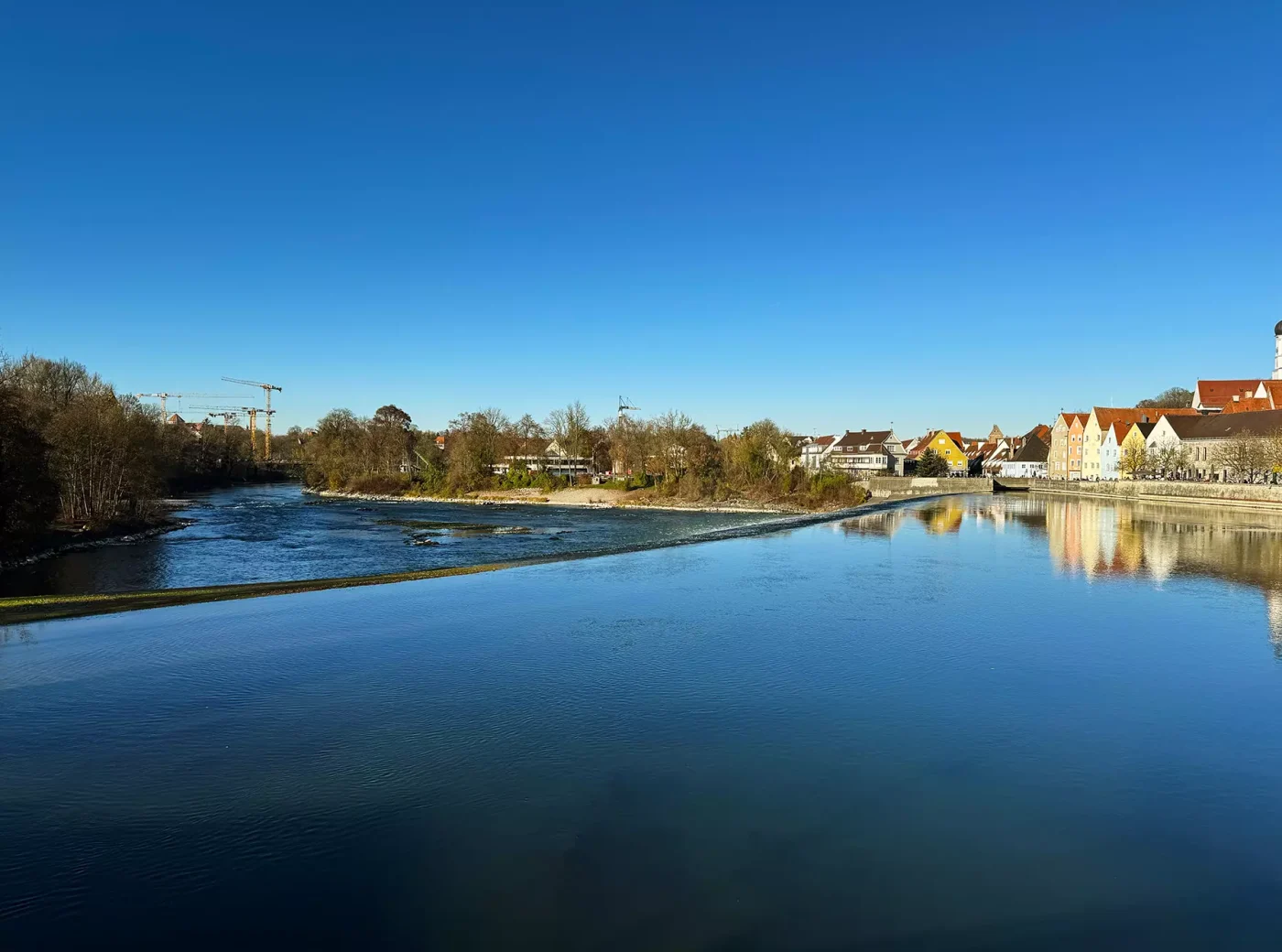
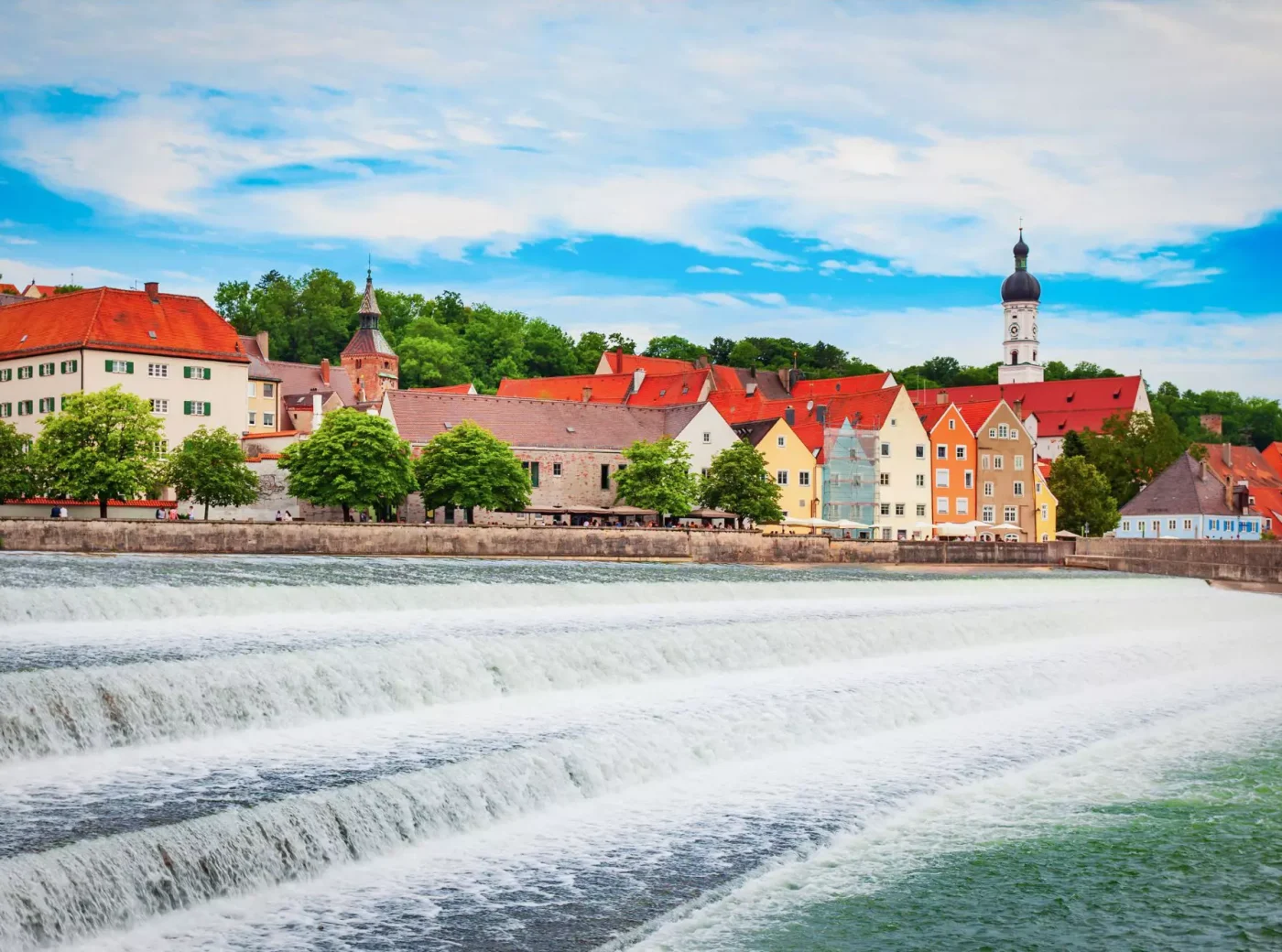
After you have dropped off your luggage at the hotel and checked in, your first impression of Landsberg begins. The historic old town, with its colorful facades and winding alleys, invites you to stroll around. At the Lechwehr (Lech weir), you can feel the power of the water, or settle down in one of the street cafés to comfortably arrive with a cup of coffee and soak up the special atmosphere of the town.
Hotel (example): Arthotel ANA Goggl
From Landsberg am Lech to Mundraching
Your hike on the LechExperiencePath begins in the historic old town of Landsberg am Lech, whose medieval walls, the Hohe Turm (High Tower), and picturesque squares provide an atmospheric prelude. After just a few steps, you leave the lively town and follow the River Lech upstream into a diverse landscape of riparian forests, meadows, and small lakes. You soon reach the wildlife park (Wildpark), a striking rock and water landscape with a small lake that has been one of the most popular excursion destinations in the region for generations. 'Teufelsküche' (Devil's Kitchen), einer markanten Fels- und Wasserlandschaft mit kleinem See, die seit Generationen zu den beliebtesten Ausflugszielen der Region zählt.
You follow the path to Pitzling, where the small castle chapel holds a special art-historical moment. Here, Dominikus Zimmermann, the later builder of the world-famous Wieskirche, first tried his hand as a painter and soon realized that his great talents lay in architecture. Directly behind Pitzling, the ascent to the Hangleite begins. Here you hike through the quiet Schlegelwald forest. A section that is particularly atmospheric with its interplay of shadow, light, and wide views. The tranquil forest accompanies you down to Mundraching, a small village with typical Upper Bavarian charm. Well-kept farmhouses, gentle fields, and a quiet village street characterize the appearance of the village.
Just a few minutes' walk from the village center lies your day's destination, the Landhotel Römerkessel. Here you can end your hiking day in a cozy atmosphere with good regional cuisine, warm hospitality, and a quiet view over the gentle hilly landscape of the Lechrain area .
Hotel (example): Landhotel Römerkessel
distance
climb
descent
duration
From Mundraching to Schongau
From the Landhotel Römerkessel, the Lech Experience Trail leads through open meadows and light forests towards Mundraching. A short detour (approx. 1.5 km one way) to the 'Balkon Oberbayern' (Balcony of Upper Bavaria) is worthwhile: from here you can enjoy an impressive panoramic view over the loops of the Lech right up to the Alps. Shortly after, you reach Epfach, one of the oldest settlement areas in Bavaria. The former Roman Abodiacum was founded as early as 15 BC.
On the Lorenzberg hill, Roman milestones and the Lorenzkapelle (Lorentz Chapel) commemorate this era. In the small Roman Museum, you gain exciting insights into life along the Via Claudia Augusta. The trail continues with a gentle ascent to Forchau and then along an old arm of the Lech, which is now a habitat for numerous waterfowl. The next village is Kinsau, picturesquely situated on a post-glacial gravel terrace. The parish church, with Wessobrunn stucco and works by Lorenz Luidl , was once an important pilgrimage church. Steps lead you up again to the Lech slope, which you follow for a while. From here, magnificent views open up of the Lechtal valley, the Kinsau dam, and the hill of Reichling. A quiet forest section brings you to Hohenfurch, where a cozy beer garden invites you to take a break. The parish church and the small 'Sparrenkapelle' chapel point to the village's rich history.
Subsequently, the trail continues to the St. Ursula Chapel before diving back into the forest. You hike along the edge of the slope to the highest point of the stage at the Schwalbenstein , with an impressive view of the Lech flowing deep below, as well as the Hoher Peißenberg mountain and the Alps. Afterwards, the route continues variedly until the forest opens up and the first houses of Schongau become visible. A small road takes you into the town.
The historic old town is worth a visit: it is surrounded by largely preserved town walls and impresses with the 15th-century Ballenhaus , the parish church with Rococo furnishings by Dominikus Zimmermann and the atmospheric Marienplatz. Schongau, the gateway to the Pfaffenwinkel region, forms a beautiful conclusion to this impressive stage along the Lech Experience Trail.
Hotel (example): Hotel Rössle
distance
climb
descent
duration
From Schongau to Urspring
You leave the historic old town of Schongau through the gate of the Polizeidienerturm (Police Servant's Tower) . Steps lead down the slope, past the outdoor swimming pool, and back to the riverside path of the Schongau reservoir (Schongauer Lechstausee). A short detour up onto the high dam opens up a wide view over the water surface before you reach the quiet district of Dornau. At the horse farm, the path leads back to the edge of the Lech slope. The large reservoir flashes into view repeatedly between the trees, spanned by an imposing bridge. You continue hiking through the forest, underpass the road bridge of the B17/B472, and reach the Heidewiesen (Heide Meadows), a protected natural monument. The park-like landscape was created by former grazing and is now home to rare, strictly protected plant species, including orchids.
The Lech Experience Trail now leads predominantly through shady forest, sometimes closer, sometimes further away from the slope of the Lech. Finally, the landscape opens up, and you meet the historical course of the Roman Via Claudia Augusta. Across open meadows, the view sweeps all the way to the Alps and the small chapel on the Auerberg on a clear day. A first taste of the alpine character of the upcoming stages. A little later you reach the nature highlight of this route: the Litzau Loop (Litzauer Schleife). From several viewpoints, you can enjoy impressive deep views of the wild green to turquoise shimmering Lech, which flows here in a wide arc through the rock landscape. The loop is an important retreat area for rare animal and plant species such as the marsh gladiolus or the small common rockrose. Its current appearance is thanks to courageous nature conservation that once prevented the construction of another Lech weir.
Shortly before Burggen, the Lech Experience Trail turns south, passes the Forchenmühle (Forchen Mill), and leads alternately through forest and open meadow landscape. After the few houses of Dessau, you soon reach Weir 4 (Stauwehr 4). From here, an impressive view opens up into the rock faces of the Hirschau scree cone and up to the high walls of the Litzau Loop. The Lech is crossed at this point, and the Ammergau Alps are already in front of you. The path then leads through a species-rich sulfur moor – a rare biotope – and on to the Urspring reservoir (Lechspeicher Urspring). The surroundings offer swimming opportunities as well as beautiful spots on the banks. Along the lakeshore and through idyllic floodplain areas, you finally reach the characteristic rapids that mark the end of this stage.
Hotel (example): Gasthaus Drei Mohren
distance
climb
descent
duration
From Urspring to Roßhaupten
After the riverside path at the Lechsee Urspring (Urspring Lech Lake), the Lech Experience Trail continues south on the east side of the bridge. You first hike directly along the water, pass quiet riparian forests, and cross several small footbridges that constantly allow charming views of the riverbed, passing directly by the riverside biotope at the Schwerblmühle. You soon reach the high dam near Prem, which you cross. From Helmenstein, the trail climbs gently over picturesque hills. At the Rehle farm, a bench invites you to take a rest with an unobstructed view of the Alps. The path then leads through a shady forest section and on to an isolated farmstead. On varied paths, you finally reach the Schmutterweiher or Schmuttersee (Schmutter Pond or Lake). The dark moor water appears mysterious and offers a refreshing opportunity for swimming on warm days.
The journey continues over the gently rolling hills, past scattered farmsteads, always accompanied by the panorama of the nearby mountains. The trail leads you into the village of Tiefenbruck. Just a few minutes' walk away is the information center at the Forggensee power plant, which offers exciting insights into the creation and significance of the large reservoir. The most varied section begins behind Tiefenbruck. The trail climbs through the wooded slopes of the former Illasberg Gorge , which is now submerged in the Forggensee. Afterwards, you reach the Mangmühle (Mang Mill), an idyllic farm with many animals. Sheep, goats, and donkeys graze in the meadows, while geese and magnificent trout can be observed in the ponds.
Another forest section leads down to the Roßhaupten boat landing. From here, a scheduled ship operates across the Forggensee towards Füssen during the season. However, it is worthwhile to continue the short walk to the natural bathing spot in Roßhaupten, which offers a wonderful view across the lake to the now tangibly close mountains.
Alternatively, a path next to the cut of the Tiefental Valley leads up to the bridge that spans the impressively deep valley. From here, it is only a few minutes to the center of Roßhaupten.
History and Culture Along the Way
The area around Roßhaupten is rich in history. The Roman Via Claudia Augusta, which connected Northern Italy with present-day Augsburg, once ran not far from the Mang Mill. At the Tiefental Bridge, a statue commemorates the legend of Saint Magnus, who is said to have conquered a dragon here in the eighth century. Regional history comes alive in the village museum , where you can learn more about early iron processing and see a reconstructed blast furnace. The information center for the Via Claudia is freely accessible regardless of museum opening hours.
Hotel (example): Beim Lipp
distance
climb
descent
duration
Von Roßhaupten nach Füssen
The final stage of the Lech Experience Trail begins at the Tiefental Bridge. After a brief look into the deeply cut valley and onto the lake, you hike past a campsite and follow the path towards the distinctive peaks of Tegelberg and Säuling. The trail then leads you to the sailing harbor on the Forggensee. In the spring months, when the lake is not yet fully dammed, a section of the historic Via Claudia can be walked here, which otherwise disappears under water. Parts of the old Roman road repeatedly emerge from the largely drained lake until the Lech fills the basin again in early summer.
A little later you reach a hill with a Roman milestone and a lovely resting place. From this viewpoint, at the foot of which lies the small village of Dietringen with a boat landing and bathing bay, you can enjoy an impressive panorama across the Forggensee nd as far as the Ammergau and Tannheim mountains. The journey continues to Osterreinen. The village offers a campsite, a modern marina, and a popular bathing spot. The hiking trail leads directly along the shore to the next stop for the Forggensee boat trip and then around the Café Maria with its inviting beer garden.
Now the path leaves the lake for a while. You follow the Forggensee circular path around a reed bay and then hike along quiet roads to the Festspielhaus (Festival Hall) in Füssen. The striking building, with its romantically laid-out lakeside gardens, was opened for the premiere of a musical about King Ludwig II. From here, there is a fantastic view across the lake to Neuschwanstein Castle, which is visibly enthroned on a rock.
A quiet footpath with beautiful mountain and castle views finally leads you into the old town of Füssen. Via the Kaiser-Maximilian-Platz, past historic town houses and small shops, you reach the banks of the Lech again. The Lech Experience Trail ends at the Lechfall (Lech Fall) . At this deeply cut rocky gorge, the river plunges into the depths – an impressive conclusion to the tour. On the opposite side begins the Lechweg (Lech Trail), a certified long-distance hiking trail that follows the river to its source area near the Arlberg.
Füssen: Culture, History, and a Worthy Conclusion to Your Hike
Füssen is considered one of the oldest settlements on the northern edge of the Alps and impresses with an exceptionally rich cultural history. The Hohe Schloss (High Castle), once the summer residence of the Augsburg prince-bishops, now houses a branch gallery of the Bavarian State Painting Collections. Right next door is the former Benedictine monastery of St. Mang, whose roots reach back to the eighth century. The magnificent Baroque rooms have been preserved to this day, and the Museum of the Town of Füssen showcases one of Europe's most significant collections of historical lutes and violins. The tradition of instrument making began here as early as the sixteenth century, when the first guild of lute makers was founded. Also particularly worth seeing is the 'Füssener Totentanz' (Füssen Dance of Death) from 1602 in the Annakapelle (Anna Chapel), the oldest of its kind in Bavaria. If you still have time, an additional day in Hohenschwangau is worthwhile. Here you will find the royal castles of Neuschwanstein and Hohenschwangau as well as the Museum of the Bavarian Kings. Behind the Lechfall, the Ziegelwies Forest Experience Centre invites you for a detour with a treetop path that is almost fifty meters high and around four hundred and eighty meters long. A boat trip across the Forggensee is also an unforgettable experience, showing the landscape with its mountains and castles from its most beautiful side.
Hotel (example): Hotel Sonne
distance
climb
descent
duration
Departure or extension
After eventful hiking days along the Lech river, it's time today to say goodbye or continue the journey a little further. If you have enough time, enjoy the charming old town of Füssen one more time, stroll through the winding alleys, or visit the famous royal castles of Neuschwanstein and Hohenschwangau—a fitting conclusion to your hike.
Should you wish to experience the special atmosphere along the river for even longer, there is the option to continue your route on the Lechweg (Lech Trail) all the way to Lech am Vorarlberg. Alternatively, the König-Ludwig-Weg (King Ludwig Trail) invites you to a cultural-historical extension to Starnberg. Hike in the footsteps of the Bavarian 'fairytale king' through magnificent pre-alpine landscapes.
No matter what you decide, the Lech and its stories will surely accompany you further in your thoughts for a while.
Day 1
Arrival in Landsberg am Lech
Arrival by Train
If you are arriving by train, please go to the train station in Landsberg am Lech. From there, walk across the Karolinenbrücke (Karolinen Bridge) into the old town. After a total walk of 500 meters, you will reach the hotel on the right side.
Arrival by Car
If you would like to arrive with your own vehicle, there are various options in Landsberg. The hotel only has a small number of parking spaces and cannot provide these for the entire hiking week. The closest parking garage is the Schloßberg parking garage.
In Landsberg am Lech angekommen
After you have dropped off your luggage at the hotel and checked in, your first impression of Landsberg begins. The historic old town, with its colorful facades and winding alleys, invites you to stroll around. At the Lechwehr (Lech weir), you can feel the power of the water, or settle down in one of the street cafés to comfortably arrive with a cup of coffee and soak up the special atmosphere of the town.
Hotel (example): Arthotel ANA Goggl
Day 2
From Landsberg am Lech to Mundraching
Your hike on the LechExperiencePath begins in the historic old town of Landsberg am Lech, whose medieval walls, the Hohe Turm (High Tower), and picturesque squares provide an atmospheric prelude. After just a few steps, you leave the lively town and follow the River Lech upstream into a diverse landscape of riparian forests, meadows, and small lakes. You soon reach the wildlife park (Wildpark), a striking rock and water landscape with a small lake that has been one of the most popular excursion destinations in the region for generations. 'Teufelsküche' (Devil's Kitchen), einer markanten Fels- und Wasserlandschaft mit kleinem See, die seit Generationen zu den beliebtesten Ausflugszielen der Region zählt.
You follow the path to Pitzling, where the small castle chapel holds a special art-historical moment. Here, Dominikus Zimmermann, the later builder of the world-famous Wieskirche, first tried his hand as a painter and soon realized that his great talents lay in architecture. Directly behind Pitzling, the ascent to the Hangleite begins. Here you hike through the quiet Schlegelwald forest. A section that is particularly atmospheric with its interplay of shadow, light, and wide views. The tranquil forest accompanies you down to Mundraching, a small village with typical Upper Bavarian charm. Well-kept farmhouses, gentle fields, and a quiet village street characterize the appearance of the village.
Just a few minutes' walk from the village center lies your day's destination, the Landhotel Römerkessel. Here you can end your hiking day in a cozy atmosphere with good regional cuisine, warm hospitality, and a quiet view over the gentle hilly landscape of the Lechrain area .
Hotel (example): Landhotel Römerkessel
distance
climb
descent
duration
Day 3
From Mundraching to Schongau
From the Landhotel Römerkessel, the Lech Experience Trail leads through open meadows and light forests towards Mundraching. A short detour (approx. 1.5 km one way) to the 'Balkon Oberbayern' (Balcony of Upper Bavaria) is worthwhile: from here you can enjoy an impressive panoramic view over the loops of the Lech right up to the Alps. Shortly after, you reach Epfach, one of the oldest settlement areas in Bavaria. The former Roman Abodiacum was founded as early as 15 BC.
On the Lorenzberg hill, Roman milestones and the Lorenzkapelle (Lorentz Chapel) commemorate this era. In the small Roman Museum, you gain exciting insights into life along the Via Claudia Augusta. The trail continues with a gentle ascent to Forchau and then along an old arm of the Lech, which is now a habitat for numerous waterfowl. The next village is Kinsau, picturesquely situated on a post-glacial gravel terrace. The parish church, with Wessobrunn stucco and works by Lorenz Luidl , was once an important pilgrimage church. Steps lead you up again to the Lech slope, which you follow for a while. From here, magnificent views open up of the Lechtal valley, the Kinsau dam, and the hill of Reichling. A quiet forest section brings you to Hohenfurch, where a cozy beer garden invites you to take a break. The parish church and the small 'Sparrenkapelle' chapel point to the village's rich history.
Subsequently, the trail continues to the St. Ursula Chapel before diving back into the forest. You hike along the edge of the slope to the highest point of the stage at the Schwalbenstein , with an impressive view of the Lech flowing deep below, as well as the Hoher Peißenberg mountain and the Alps. Afterwards, the route continues variedly until the forest opens up and the first houses of Schongau become visible. A small road takes you into the town.
The historic old town is worth a visit: it is surrounded by largely preserved town walls and impresses with the 15th-century Ballenhaus , the parish church with Rococo furnishings by Dominikus Zimmermann and the atmospheric Marienplatz. Schongau, the gateway to the Pfaffenwinkel region, forms a beautiful conclusion to this impressive stage along the Lech Experience Trail.
Hotel (example): Hotel Rössle
distance
climb
descent
duration
Day 4
From Schongau to Urspring
You leave the historic old town of Schongau through the gate of the Polizeidienerturm (Police Servant's Tower) . Steps lead down the slope, past the outdoor swimming pool, and back to the riverside path of the Schongau reservoir (Schongauer Lechstausee). A short detour up onto the high dam opens up a wide view over the water surface before you reach the quiet district of Dornau. At the horse farm, the path leads back to the edge of the Lech slope. The large reservoir flashes into view repeatedly between the trees, spanned by an imposing bridge. You continue hiking through the forest, underpass the road bridge of the B17/B472, and reach the Heidewiesen (Heide Meadows), a protected natural monument. The park-like landscape was created by former grazing and is now home to rare, strictly protected plant species, including orchids.
The Lech Experience Trail now leads predominantly through shady forest, sometimes closer, sometimes further away from the slope of the Lech. Finally, the landscape opens up, and you meet the historical course of the Roman Via Claudia Augusta. Across open meadows, the view sweeps all the way to the Alps and the small chapel on the Auerberg on a clear day. A first taste of the alpine character of the upcoming stages. A little later you reach the nature highlight of this route: the Litzau Loop (Litzauer Schleife). From several viewpoints, you can enjoy impressive deep views of the wild green to turquoise shimmering Lech, which flows here in a wide arc through the rock landscape. The loop is an important retreat area for rare animal and plant species such as the marsh gladiolus or the small common rockrose. Its current appearance is thanks to courageous nature conservation that once prevented the construction of another Lech weir.
Shortly before Burggen, the Lech Experience Trail turns south, passes the Forchenmühle (Forchen Mill), and leads alternately through forest and open meadow landscape. After the few houses of Dessau, you soon reach Weir 4 (Stauwehr 4). From here, an impressive view opens up into the rock faces of the Hirschau scree cone and up to the high walls of the Litzau Loop. The Lech is crossed at this point, and the Ammergau Alps are already in front of you. The path then leads through a species-rich sulfur moor – a rare biotope – and on to the Urspring reservoir (Lechspeicher Urspring). The surroundings offer swimming opportunities as well as beautiful spots on the banks. Along the lakeshore and through idyllic floodplain areas, you finally reach the characteristic rapids that mark the end of this stage.
Hotel (example): Gasthaus Drei Mohren
distance
climb
descent
duration
Day 5
From Urspring to Roßhaupten
After the riverside path at the Lechsee Urspring (Urspring Lech Lake), the Lech Experience Trail continues south on the east side of the bridge. You first hike directly along the water, pass quiet riparian forests, and cross several small footbridges that constantly allow charming views of the riverbed, passing directly by the riverside biotope at the Schwerblmühle. You soon reach the high dam near Prem, which you cross. From Helmenstein, the trail climbs gently over picturesque hills. At the Rehle farm, a bench invites you to take a rest with an unobstructed view of the Alps. The path then leads through a shady forest section and on to an isolated farmstead. On varied paths, you finally reach the Schmutterweiher or Schmuttersee (Schmutter Pond or Lake). The dark moor water appears mysterious and offers a refreshing opportunity for swimming on warm days.
The journey continues over the gently rolling hills, past scattered farmsteads, always accompanied by the panorama of the nearby mountains. The trail leads you into the village of Tiefenbruck. Just a few minutes' walk away is the information center at the Forggensee power plant, which offers exciting insights into the creation and significance of the large reservoir. The most varied section begins behind Tiefenbruck. The trail climbs through the wooded slopes of the former Illasberg Gorge , which is now submerged in the Forggensee. Afterwards, you reach the Mangmühle (Mang Mill), an idyllic farm with many animals. Sheep, goats, and donkeys graze in the meadows, while geese and magnificent trout can be observed in the ponds.
Another forest section leads down to the Roßhaupten boat landing. From here, a scheduled ship operates across the Forggensee towards Füssen during the season. However, it is worthwhile to continue the short walk to the natural bathing spot in Roßhaupten, which offers a wonderful view across the lake to the now tangibly close mountains.
Alternatively, a path next to the cut of the Tiefental Valley leads up to the bridge that spans the impressively deep valley. From here, it is only a few minutes to the center of Roßhaupten.
History and Culture Along the Way
The area around Roßhaupten is rich in history. The Roman Via Claudia Augusta, which connected Northern Italy with present-day Augsburg, once ran not far from the Mang Mill. At the Tiefental Bridge, a statue commemorates the legend of Saint Magnus, who is said to have conquered a dragon here in the eighth century. Regional history comes alive in the village museum , where you can learn more about early iron processing and see a reconstructed blast furnace. The information center for the Via Claudia is freely accessible regardless of museum opening hours.
Hotel (example): Beim Lipp
distance
climb
descent
duration
Day 6
Von Roßhaupten nach Füssen
The final stage of the Lech Experience Trail begins at the Tiefental Bridge. After a brief look into the deeply cut valley and onto the lake, you hike past a campsite and follow the path towards the distinctive peaks of Tegelberg and Säuling. The trail then leads you to the sailing harbor on the Forggensee. In the spring months, when the lake is not yet fully dammed, a section of the historic Via Claudia can be walked here, which otherwise disappears under water. Parts of the old Roman road repeatedly emerge from the largely drained lake until the Lech fills the basin again in early summer.
A little later you reach a hill with a Roman milestone and a lovely resting place. From this viewpoint, at the foot of which lies the small village of Dietringen with a boat landing and bathing bay, you can enjoy an impressive panorama across the Forggensee nd as far as the Ammergau and Tannheim mountains. The journey continues to Osterreinen. The village offers a campsite, a modern marina, and a popular bathing spot. The hiking trail leads directly along the shore to the next stop for the Forggensee boat trip and then around the Café Maria with its inviting beer garden.
Now the path leaves the lake for a while. You follow the Forggensee circular path around a reed bay and then hike along quiet roads to the Festspielhaus (Festival Hall) in Füssen. The striking building, with its romantically laid-out lakeside gardens, was opened for the premiere of a musical about King Ludwig II. From here, there is a fantastic view across the lake to Neuschwanstein Castle, which is visibly enthroned on a rock.
A quiet footpath with beautiful mountain and castle views finally leads you into the old town of Füssen. Via the Kaiser-Maximilian-Platz, past historic town houses and small shops, you reach the banks of the Lech again. The Lech Experience Trail ends at the Lechfall (Lech Fall) . At this deeply cut rocky gorge, the river plunges into the depths – an impressive conclusion to the tour. On the opposite side begins the Lechweg (Lech Trail), a certified long-distance hiking trail that follows the river to its source area near the Arlberg.
Füssen: Culture, History, and a Worthy Conclusion to Your Hike
Füssen is considered one of the oldest settlements on the northern edge of the Alps and impresses with an exceptionally rich cultural history. The Hohe Schloss (High Castle), once the summer residence of the Augsburg prince-bishops, now houses a branch gallery of the Bavarian State Painting Collections. Right next door is the former Benedictine monastery of St. Mang, whose roots reach back to the eighth century. The magnificent Baroque rooms have been preserved to this day, and the Museum of the Town of Füssen showcases one of Europe's most significant collections of historical lutes and violins. The tradition of instrument making began here as early as the sixteenth century, when the first guild of lute makers was founded. Also particularly worth seeing is the 'Füssener Totentanz' (Füssen Dance of Death) from 1602 in the Annakapelle (Anna Chapel), the oldest of its kind in Bavaria. If you still have time, an additional day in Hohenschwangau is worthwhile. Here you will find the royal castles of Neuschwanstein and Hohenschwangau as well as the Museum of the Bavarian Kings. Behind the Lechfall, the Ziegelwies Forest Experience Centre invites you for a detour with a treetop path that is almost fifty meters high and around four hundred and eighty meters long. A boat trip across the Forggensee is also an unforgettable experience, showing the landscape with its mountains and castles from its most beautiful side.
Hotel (example): Hotel Sonne
distance
climb
descent
duration
Day 7
Departure or extension
After eventful hiking days along the Lech river, it's time today to say goodbye or continue the journey a little further. If you have enough time, enjoy the charming old town of Füssen one more time, stroll through the winding alleys, or visit the famous royal castles of Neuschwanstein and Hohenschwangau—a fitting conclusion to your hike.
Should you wish to experience the special atmosphere along the river for even longer, there is the option to continue your route on the Lechweg (Lech Trail) all the way to Lech am Vorarlberg. Alternatively, the König-Ludwig-Weg (King Ludwig Trail) invites you to a cultural-historical extension to Starnberg. Hike in the footsteps of the Bavarian 'fairytale king' through magnificent pre-alpine landscapes.
No matter what you decide, the Lech and its stories will surely accompany you further in your thoughts for a while.
Requirements for hikers
Summary
- Total approx 84 km over 5 hiking days
- 6 nights
- Breakfast
- Luggage transfer
- Travel documents and GPS data
- Service hotline
- €719 per person in a double room
- €949 single room

Facts about the Lech
- The Lech is one of the last largely untouched wild rivers of the Alps
- The total length is approx. 256 kilometres
- Source at Lake Formarin (Vorarlberg) at 1,793 metres above sea level
- Empties into the Danube near Marxheim (Bavaria)
- The Tyrolean Lechtal has a population of about 5,000 inhabitants between Steeg and Forchach
- Over 70 larger and smaller tributaries
- The average discharge is around 114 cubic meters per second